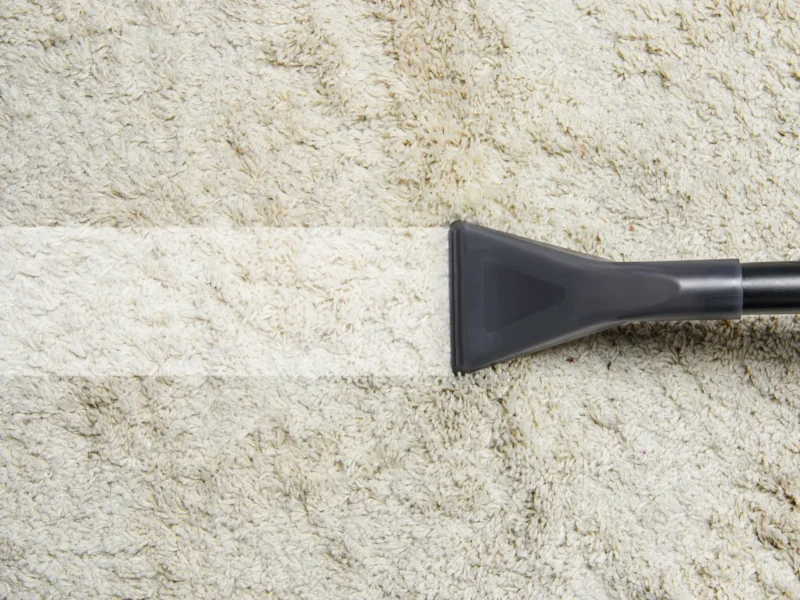
How to Remove Pet Stains and Odors from Carpet
Pet accidents are the most common carpet problem homeowners deal with, and they respond well to treatment when you catch them early. Urine needs an enzyme cleaner to neutralize it. Soap and water lift the stain from the surface but leave the odor compounds in the fibers, which pets can still detect and will return to. Solid waste requires a different first step, and odor treatment follows after.
How to Clean Dog Pee from Carpet
Blot up as much liquid as possible with a clean cloth or paper towels. Press down firmly and lift. Rubbing spreads the urine and pushes it deeper into the pad. Work from the outside edge of the wet area toward the center to contain it. Once you’ve removed as much liquid as you can, apply an enzyme cleaner directly to the area, saturating it enough to reach the carpet backing. Let it sit for 10 to 15 minutes. The enzymes need time to break down the uric acid crystals in the urine. Blot again with a clean cloth to pull out the cleaner and dissolved material. Cover the area with a clean towel and press it down with something heavy overnight to draw out remaining moisture from the pad beneath.
How to Get Dog Urine Smell Out of Carpet
If the smell persists after cleaning, uric acid crystals are still present in the carpet pad or subfloor. These crystals reactivate in humidity, which is why a spot can smell fine until a rainy day brings the odor back. Sprinkle a generous layer of baking soda over the dry area, let it sit overnight, then vacuum. If that doesn’t clear the smell, re-apply enzyme cleaner and allow it to dry before vacuuming again. For older or heavily saturated spots, the carpet pad may need replacement. No surface treatment solves a problem that has soaked through to the padding.
How to Get Dog Poop Out of Carpet
Give solid waste a few minutes to firm up before removing it. Cleaning it wet spreads the material further into the fibers. Use a plastic bag or gloves to pick up as much solid as possible, working from the outside in. Once the bulk is removed, mix one tablespoon of dish soap with two cups of cold water and apply it to the stained area with a clean cloth, blotting from the outer edge inward. Rinse by blotting with plain cold water, then apply an enzyme cleaner to address the bacteria and odor. Point a fan at the spot to dry it and prevent mold from forming in the damp fibers.
How to Clean Common Household Stains from Carpet
Different stains call for different approaches. The table below gives you a quick reference for the most common spills, followed by step-by-step instructions for each one.
| Stain | First Step | Cleaning Agent | Key Rule |
|---|---|---|---|
| Red wine | Blot immediately | Club soda + dish soap + white vinegar | Never rub; always blot |
| Coffee | Blot up liquid | Dish soap + white vinegar + cold water | Cold water only |
| Vomit | Remove solids first | Baking soda, then enzyme cleaner | Neutralize odor after stain is gone |
| Blood | Blot with cold water | 3% hydrogen peroxide | Cold water only; heat sets the stain |
| Slime | Freeze, then scrape | White vinegar + water, then dish soap | Harden with ice before scraping |
How to Get Red Wine Out of Carpet
Blot the spill with a clean white cloth. Colored cloths can transfer dye to carpet fibers. Pour a small amount of club soda onto the stain to dilute it, then blot again. Mix one tablespoon each of dish soap and white vinegar with two cups of warm water, apply to the stain, and blot from the outside edge inward. Continue until the stain lifts, then rinse by blotting with cold water. For dried red wine, dampen the area with cold water first to rehydrate it before applying the solution.
How to Get Coffee Out of Carpet
Blot up the liquid before it dries. Mix one tablespoon of dish soap, one tablespoon of white vinegar, and two cups of cold water. Apply to the stain with a clean cloth, blotting until the stain transfers from the carpet to the cloth. Use cold water only. Warm or hot water sets coffee tannins into fibers and makes the stain permanent. Rinse and dry the area. For coffee with cream or sugar, an enzyme cleaner also works because it breaks down the organic compounds in both.
How to Clean Vomit from Carpet
Scrape solids from the outside edge toward the center using a plastic scraper or spoon. Blot up any remaining liquid. Sprinkle baking soda over the area, let it absorb moisture for 15 minutes, then vacuum. Apply one tablespoon of dish soap mixed with two cups of cold water, blotting until the stain lifts. Follow with an enzyme cleaner. Vomit contains stomach acid that breaks down carpet fibers over time if you leave it untreated. Point a fan at the area to dry it and stop mold from forming in the damp fibers.
How to Remove Blood from Carpet
Use cold water only. Heat sets blood protein into fibers and makes the stain permanent. Blot the fresh stain with a cloth dampened with cold water. For dried blood, apply one tablespoon of dish soap mixed with two cups of cold water and blot to lift the material. If residue remains, apply 3% hydrogen peroxide directly to the stain and let it sit for a few minutes. Hydrogen peroxide breaks down the hemoglobin in blood without damaging most carpet fibers, but test it on a hidden spot first. Some dyed carpets lighten under peroxide. Blot up the peroxide and rinse with cold water.
How to Remove Slime from Carpet
Place an ice pack over wet slime for a few minutes to firm it up. Once hardened, scrape off as much as possible with a dull knife or spoon, working from the outside in. For the residue left in the fibers, mix two-thirds cup of white vinegar with one-third cup of water and apply it to the area, letting it sit for a few minutes to dissolve the polymer bonds. Work the solution into the fibers with a soft brush, then blot and rinse with cold water. Dish soap can lift any remaining residue after the vinegar treatment. Dry the area.
How to Get Mold Out of Carpet
Mold in carpet grows when moisture stays in the fibers or backing for more than 24 to 48 hours. It develops after floods, large spills you didn’t dry in time, or persistent humidity in poorly ventilated rooms. A musty smell that doesn’t clear with vacuuming or deodorizing is a reliable sign of mold working in the carpet or pad beneath it.
For surface mold on carpet fibers, mix one cup of white vinegar with two cups of water and apply it to the affected area. Let it sit for an hour, scrub with a stiff brush, then blot up the solution. Allow the carpet to dry with fans and open windows, then sprinkle baking soda over the dry area and vacuum after several hours. This works on minor surface mold caught early in a small area.
If mold has reached the carpet backing or pad, surface treatment won’t resolve it. Mold that penetrates the backing causes health problems and damages the subfloor over time. In that case, the carpet and pad need full removal and replacement, along with a moisture barrier or subfloor repair to prevent recurrence. No cleaning product restores a carpet once mold has set into the backing.
How to Deodorize and Maintain Your Carpet
Baking soda is the most practical deodorizer for regular maintenance. Sprinkle it over the carpet, let it sit several hours or overnight, then vacuum. It absorbs odors without adding fragrance or chemicals. For stronger odors, a light mist of equal parts white vinegar and water left to air dry neutralizes odor compounds without leaving residue. Avoid saturating the carpet with any solution, which causes the same moisture problems you’re trying to clear.
For routine carpet care, keep these practices in mind:
- Vacuum at least once a week in high-traffic areas and twice a week in homes with pets
- Deep clean every 12 to 18 months without pets; every 6 to 12 months with pets or children
- Use walk-off mats at exterior doors to reduce the dirt and moisture tracked onto carpet
- Rotate furniture periodically to prevent permanent compression in the same spots
- Wipe spills within minutes — the pad absorbs liquid fast, and moisture in the pad is harder to remove than moisture in the fibers
- Address ripples and bubbling promptly — loose carpet is a trip hazard and wears unevenly at the raised sections
Carpet stretching fixes ripples and bubbles that form when carpet loses tension over time from humidity, furniture movement, or an initial installation done with a knee-kicker instead of a power stretcher. A professional re-stretch pulls the carpet taut and re-secures it to the tack strips at the room’s perimeter. A knee-kicker alone won’t produce a lasting result on a full room and can leave the carpet with uneven tension across the floor.
When Cleaning Isn’t Enough
Most stains and odors respond to the methods above when you address them fast. Some situations go beyond what cleaning can fix: mold in the backing, pet odor soaked into the subfloor, carpet saturated more than once, fibers worn to the point where the texture is gone, or staining that has set through repeated cleaning attempts. Continuing to clean a carpet in that condition costs time and money without changing the result.
Replacement gives you the opportunity to choose a fiber type and construction built for your household — one that handles spills more effectively, holds up to pets, or fits a different look. Filar Flooring handles carpet flooring installation in Sarasota, FL, from material selection through finished installation. Contact us today for a free consultation.
Contact us for a free in-home estimate. We'll help you find the perfect flooring solution for your home and budget.
GET A FREE QUOTE